On 25 April 2026, Careif Associate Dr Mariam Bhaila and Professor Rachel Tribe (Chair of Careif) delivered a workshop on Understanding trauma and working in a trauma-informed way for the Sri Lanka Psychological Association.
A shared question, many answers
We began the session by reflecting on the word trauma, asking the audience: "What comes to mind when you hear the word 'trauma'?" Using a live polling tool, the responses were gathered in real time and displayed as a word cloud on screen. What came back was varied: "fear," "pain," "abuse," alongside "psychological distress," "hands on the face," "crying," "wounded child," "unfulfilled emotions," "lasting effects."
Some responses were somatic, located in the body, while others were more emotional states, and some were closer to memory or image than definition. Sitting with all of it together said something before the workshop had properly begun: trauma isn't one thing, it carries different layers depending on who's naming it, and each person in that room was making sense of it in their own way.
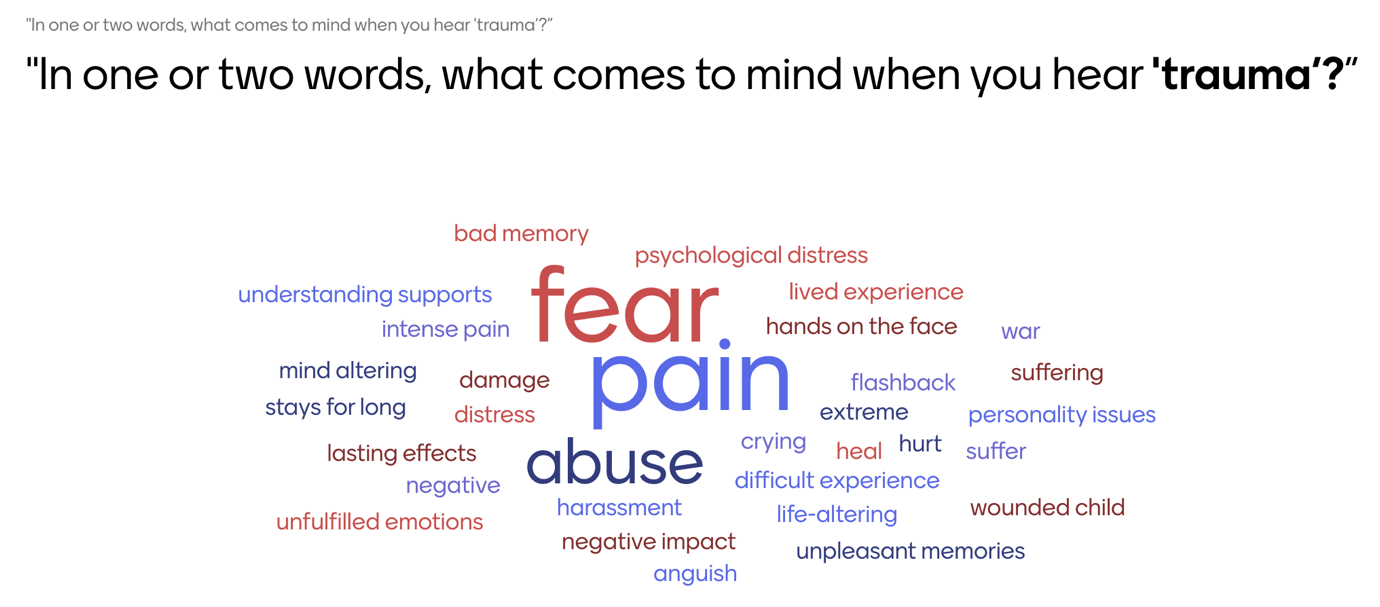
We reflected on just how varied the word "trauma" can be, and how personal the process of making sense of it is. It also pointed to something every practitioner carries into a session: each client will make sense of what happened to them in their own way, shaped by their own history, culture and language, long before it ever reaches the therapy room.
From "what's wrong with you" to "what happened to you"
Much of the session explored a shift central to trauma-informed practice: asking not what's wrong with you but what happened to you. That question changes whether a person's responses are read as symptoms to be treated, or as something that once made sense, given what they lived through.
Stigma came up repeatedly in the discussion, the way it keeps "trauma" and "mental health" close to ideas of "being crazy" for many, professionals included. Participants also spoke about trauma at a collective level, the legacy of the civil war, and of the 2004 tsunami and recurring floods, as experiences that had shaped families and communities well beyond any one individual.
Trauma here, several people reflected, is rarely a single event; it's carried across generations and communities as much as it's held by any one person. The conversation kept returning to something more specific than theory: what working this way actually looks like, in this context, for these clients.
What participants took away
One participant, still training, wrote in their post-session feedback:
"I'm still a Psychology undergraduate. But when I become a professional counsellor one day hopefully, I will try to understand the context more in a thoughtful manner."
Another described how the session might shift their day-to-day practice:
"I will be more aware of my language use and evaluate it for anything that might stem from or contribute toward greater stigma or just unhelpful responses to clients. Noticing the impact of regulation, I'd like to train myself in coregulation as well, maybe by practicing grounding techniques with a client in session so we share in the experience and build trust as well."
Several other participants described similar shifts they wanted to carry into their own work, including exploring a client's understanding of their distress and the context surrounding it, noticing threat responses, and paying closer attention to non-verbal cues.
Barriers to working this way
Participants also reflected on what gets in the way of trauma-informed practice in their own settings:
"In the context of Sri Lanka, trauma comes with stigma. So lack of knowledge is a significant barrier."
"Stigma, words like 'trauma' and 'mental health' are culturally looked down on and compartmentalised to the idea of 'being crazy.”
Alongside these, people named time pressure, institutional culture, fear of retraumatising a client, and vicarious trauma from repeated exposure to others' distress.
Closing reflections
The session explored what trauma means, how it lives in the body and shapes behaviour, and what it truly means to work in a trauma-informed way, not as a technique or a checklist, but as a genuine shift in how we see and respond to the people we work with. What stayed with me afterwards was how much I learned from the group myself.
Conversations about culture, history, identity, and how distress is expressed and understood across communities ran through the discussion, and working across borders like this is a reminder that trauma doesn't mean the same thing everywhere: how it's understood, spoken about, or held in silence shifts with language, with stigma, with the context someone is living in. It's the kind of exchange Careif has tried to hold across its work in different countries.