
Beyond individual care: addressing racial inequities in mental health
A new report from the Centre for Mental Health, funded by the London Anti-Racism Collaboration for Health (LARCH) and delivered by the Race Equality Foundation and Thrive LDN, highlights how racism is deeply embedded in systems and institutions, negatively affecting mental health throughout the lifespan.
The report, Shifting power, is based on an extensive literature review, a mapping of current interventions, and three online workshops with 40 participants sharing views on population-level anti-racism actions. Below, we summarise key insights, including the report’s valuable and comprehensive practical recommendations.
What does the literature tell us?
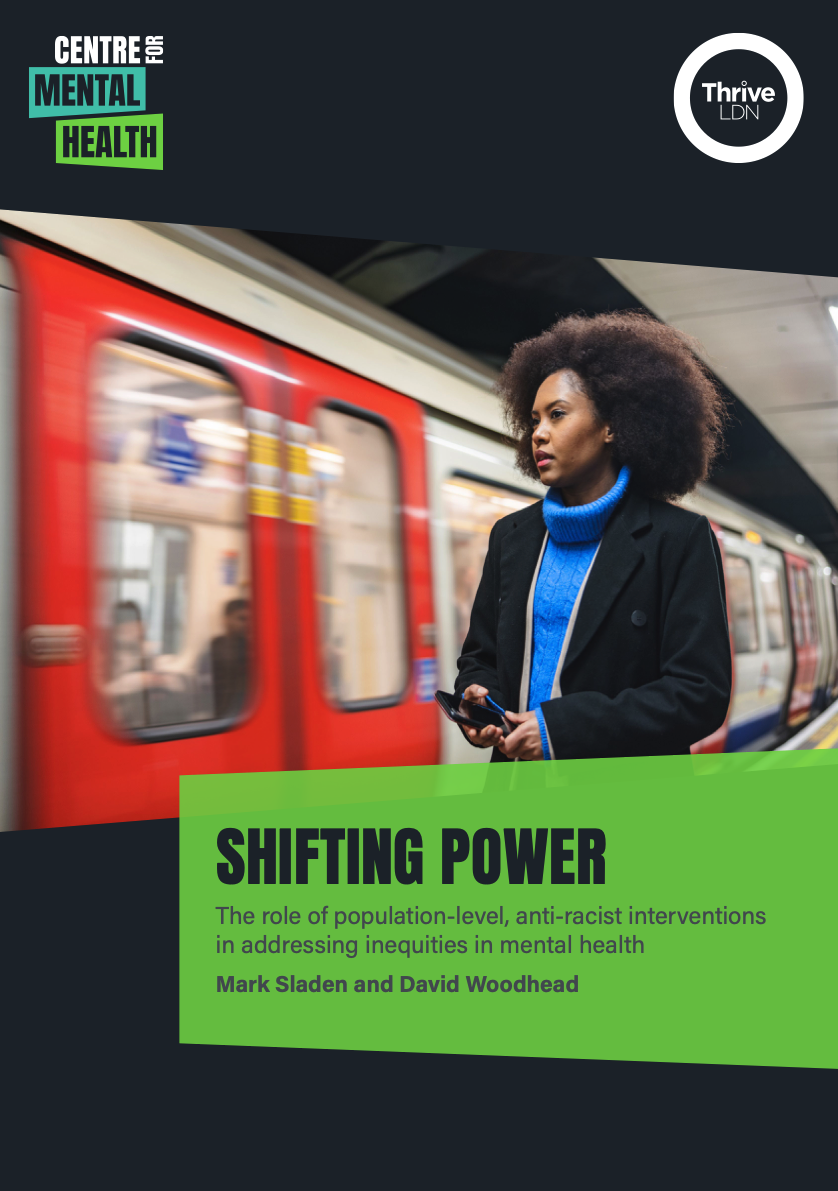
Shifting power
Racism does not occur only as a series of separate incidents but functions as a system that influences outcomes across communities and generations. It includes structural components, such as social, political, and economic ones, and ideological ones, including ideas about race, power, and hierarchy. While we acknowledge different forms of racism, structural and institutional racism are especially important when discussing population-based interventions because they are deeply woven into everyday life through education, healthcare, and legal systems.
These systems often privilege some groups while disadvantaging others, and the effects are visible in rates of poverty, employment, wage gaps, career advancement, housing, services, and more. These advantages and disadvantages are often evident in health inequalities. Literature shows that racialised communities severely underutilise mental health services, leading to worse mental health outcomes in such individuals. The report also mentions racial trauma as an important public health concern and the importance of trauma-informed care, which we covered in a previous blog.
When different organisations, including CareIf, discuss anti-racism, what exactly does that term mean? We can view it as a set of guiding principles for how organisations and systems should behave. It involves a commitment to changing patterns that cause unequal outcomes and challenging power to distribute resources more fairly, even if that makes people uncomfortable by questioning the status quo. Anti-racism is therefore not just about naming racism but about changing the conditions that allow it to persist.
Moving beyond individual care
Thus, anti-racism interventions should focus on broader issues beyond individual clinical interventions. Population-based interventions, defined as preventive measures focused on an entire population or a subgroup, can have a broad impact on health outcomes, reducing health inequities and improving the overall quality of life for more people.
Such interventions should focus on health promotion, consider social determinants of health, and incorporate a clear understanding of the target population and a multidisciplinary approach. Another key principle is community engagement and coproduction to further build trust and confidence in these policies.
The report maps 23 population-level interventions across the UK. Many of them are community-centred and include mental health information and advice, wellbeing and skills development, language support, peer mentoring, service improvement, advocacy, and campaigning. These examples show that mental health support does not always need to begin in a clinical setting. For many racialised communities, support is more accessible when it is culturally competent, community-led, and built around trust.
From consultation to shifting power
One of the report's strongest messages is that community engagement must be meaningful. Coproduction should involve sharing power, compensating people for their lived experience roles, and establishing accountability for how community insight is utilised, rather than merely asking communities for feedback after decisions are already made.
The workshops described in the report also show that racism is experienced as a daily stressor. Participants described racism as something that affects housing, policing, immigration systems, education, employment, and healthcare. This means that mental health inequalities cannot be separated from wider social conditions.
What needs to change?
The report presents several key recommendations for mental health systems and organisations. It emphasises that racial trauma should be recognised as a core public health issue. Services need to provide choice, safety, and cultural competence while shifting away from models that rely too heavily on coercive practices. Community-led organisations require stable funding to enable planning, growth, and workforce support.
Equity should also be made visible and measurable through improved data collection, transparent reporting, and ongoing monitoring of access, experiences, and outcomes. Lastly, system-wide staff support is crucial for delivering anti-racist, trauma-informed, and culturally competent care, which involves training, reflection, supervision, and clear pathways for racialised staff to advance into leadership roles.
At Careif, this message strongly resonates. Mental health is not solely about individual symptoms or clinical treatment; it is also influenced by social factors such as power, exclusion, belonging, and justice. While population-level, anti-racist strategies are not substitutes for clinical care, they are essential for ensuring that care is fair, accessible, and effective. These strategies emphasise the importance of prevention, community leadership, and structural change in mental health. Careif appreciates this report and its advocacy for shifting power dynamics and enhancing community-led support.